

In Vietnam, where 99.5% of children are exposed to multiple climate and environmental shocks (UNICEF, 2023), climate change is already threatening children’s learning, health and safety. Yet climate change education remains unevenly implemented and often theoretical.
Save the Children in Vietnam is advancing a child-centered, system-aligned model that enable children to adopt green behaviors and climate resilient practices daily through the development and digitization of contextualized learning materials, teacher capacity building, and structured student participation mechanisms. The approach also strengthens experiential learning through a Climate Change Education Center and connects classrooms with ecosystem restoration and community resilience efforts.
In 2025, 13,660 children engaged in climate education initiatives, with 258 youth leading climate campaigns. Evidence shows measurable gains in knowledge and sustained climate-friendly practices, underscoring Save the Children’s role in shaping scalable, policy-aligned climate education that empowers children to contribute meaningfully to a more sustainable future.
Why Climate Change Education matters in Vietnam
Climate change education is especially critical in Vietnam where children are among the most climate exposed and where climate impacts already disrupt schooling, health and daily life.
According to UNICEF’s Children’s Climate Risk Index (2023), 99.5% of children in Vietnam – approximately 26.2 million – are exposed to at least 3 climate and environmental shocks. Extreme weather events not only disrupt schooling but also increase health risks such as waterborne diseases and heat-related illnesses. Save the Children’s “Born into the climate crisis 2” report (2025) shows that children born in 2020 will face on average 2-7 times more extreme weather events such as wildfires, crop failure, droughts, floodings, and heatwaves, across their lifetimes, compared to their grandparents’ generation born in 1960.
The impacts are visible within the education system. Between 2011, 2012, 2018 and 2020 alone, 5,929 classrooms and functional rooms were damaged and 2,723 school sites were affected by disasters. From 2012 to 2017, the number of damaged schools quadrupled. A 2020 survey across 25,000 students in 8 Asian countries, including Vietnam, found that 78% of students reported that climate change negatively affects their learning.
Climate change is therefore disrupting education systems while simultaneously demanding new knowledge and skills. However, climate change education in schools in Vietnam remains optional, theoretical, fragmented, and unevenly implemented, leading children to lacking of practical skills and adaptive behaviors needed to stay safe, continue learning and contribute to community resilience. Although the Ministry of Education and Training (MOET) issued reference materials on disaster risk reduction (DRR) and climate change education in 2012, implementation largely depends on local budget availability and disaster exposure levels. Experiential learning, field-based activities, and locally contextualized materials remain limited, particularly for children aged 12–15 in highly exposed rural, coastal and highland areas.
Without meaningful, engaging, and applied climate change education, children remain vulnerable not only to climate shocks, but also to exclusion from climate solutions and decision-making processes.
Save the Children’s approach for upcoming “Greeneration(s)”
Save the Children in Vietnam advances a child-centered, system-aligned climate change education approach built on 3 pillars: Transforming schools, expanding experiential learning, and linking education to sustainable ecosystem restoration and local livelihoods. What differentiates this approach is not only the integration of climate content, but also the intentional positioning of children as active participants and leaders of change.
In-school transformation
To meet children’s growing needs for practical, relevant climate knowledge and skills, Save the Children has promoted an innovative, child-centered and system-aligned approach that embeds climate change education into everyday school life. Working closely with local partners, Save the Children has developed and digitized context-specific climate change education materials, accessible through the online platform hocmoingay.sciv.vn and increasingly shared via provincial education portals in Hai Phong and Thanh Hoa, strengthening institutional ownership and potential for replication. Lessons are contextualized, practical, and interactive, bridging theory and local climate realities, making the knowledge more engaging to students. Teachers are also trained and supported to integrate climate content into both relevant subjects and extracurricular activities, aligning with national education frameworks.

Photo: A course on climate change on Save the Children’s e-learning platform.
The child‑led Green School Certification (GSC) model offers a practical, scalable solution by integrating climate and environmental education into school systems while empowering children - especially girls - to lead real climate actions. Through eco‑clubs, environmental audits, innovation challenges and student-led initiatives, children move beyond awareness to actively shaping climate-friendly practices within their schools. Co‑designed with Department of Education and Training (DOET), teachers, and students, the model strengthens school governance, enhances teacher competencies, and uses digital tools for evidence‑based monitoring. Early implementation shows high engagement and strong government commitment to scale the model province‑wide. GSC demonstrates how child agency, low‑cost tools, and system-level collaboration can transform schools into hubs of climate resilience.
Experiential learning
Recognizing that behavioral change requires lived experience, Save the Children supported the establishment and operation of a Climate Change Education Center at Hong Duc University, Thanh Hoa province – one of the first dedicated climate change education hubs in Vietnam.
The Center provides spaces for young people to engage with renewable energy demonstration models, simulation games on deforestation and flooding, practical experiments and immersive learning tools. By connecting scientific concepts with real-world climate risks, students are enabled to analyze impacts, explore solutions, and develop risk assessment skills. Climate change education is no longer abstract; it becomes visible, relatable, and actionable.
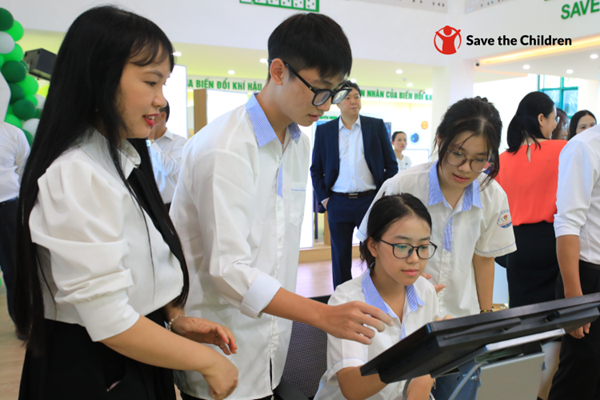
Photo: Students engaging with learning tools at the Climate Education Center in Thanh Hoa.
Beyond a learning space, the Center serves as a demonstration model for experiential climate education that can be replicated in other provinces. By anchoring the model within a public university, Save the Children aims to institutionalize hands-on climate learning and strengthen pathways for broader scale-up across the education system.
Linking climate literacy with community resilience
Save the Children extends climate change education beyond the classroom by deliberately connecting school-based learning with ecosystem restoration and community resilience initiatives, particularly in climate-vulnerable areas such as Ca Mau. Students are equipped with climate knowledge and soft skills that enable them to understand how climate change directly affects their families and surroundings, and lead awareness raising activities on related climate issues among their own communities.
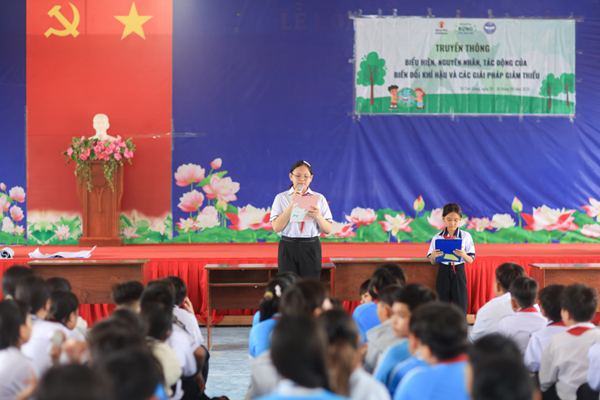
Photo: Students facilitating communication event on climate impacts in Ca Mau.
By positioning young people as facilitators and communicators within their own communities, Save the Children transforms climate education into a bridge between schools and local resilience efforts. Climate literacy thus becomes a catalyst for intergenerational dialogue and collective action, rather than remaining restrained within classroom walls.
Models in action: Evidence of change
The impact of this approach is measurable. In 2025 alone, 13,660 children engaged in climate education initiatives supported by Save the Children in Vietnam, and 258 children and youth led climate campaigns. These numbers reflect not only scale but also a shift in role: children are initiating and implementing solutions within their own environments.
Endline data from the “Climate Education for Sustainable Development” project (Oct 2024 - Dec 2025) show significant progress in knowledge, engagement, and behavior. The proportion of students with sufficient climate knowledge increased from 25% to 56%, while those expressing strong interest in climate issues rose from 83% to 96%. Most notably, students implementing 5 or more climate-friendly actions in their daily lives increased from 53% to 81%. Teachers reported stronger classroom engagement and greater confidence in integrating climate topics, and most schools expressed readiness to sustain activities beyond the project period, indicating growing institutional ownership.
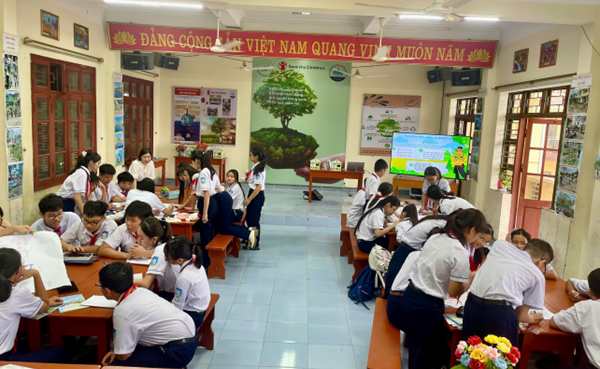
Photo: Teacher integrating climate content in class activities.
Experiential learning has also shown tangible reach. Since its establishment in 2024, the Climate Change Education Center in Thanh Hoa has delivered nearly 50 climate education classes, engaging over 2,000 high school students and 5,000 university students, alongside supporting creative student-led communication campaigns.
Beyond schools, climate change communication activities connect children to their communities. In 2025, 853 students and 795 community members participated in awareness sessions on climate risks and the importance of mangrove forests. These dialogues illustrate how children and youth can influence household and community practices, reinforcing the idea that climate literacy must extend into daily life and local livelihoods.
The human dimension underscores these outcomes. Linh, a 13-year-old student from Hai Phong, transformed from viewing climate change as “unusual weather” to leading peer awareness efforts and promoting sustainable habits at home. In Thanh Hoa, Tuan, a once-shy student gained the confidence to speak publicly through climate club activities and experiential learning. Such stories illustrate a critical shift: when students are given structured opportunities to lead, climate education moves from information delivery to empowerment, driving sustained behavior change and peer influence.
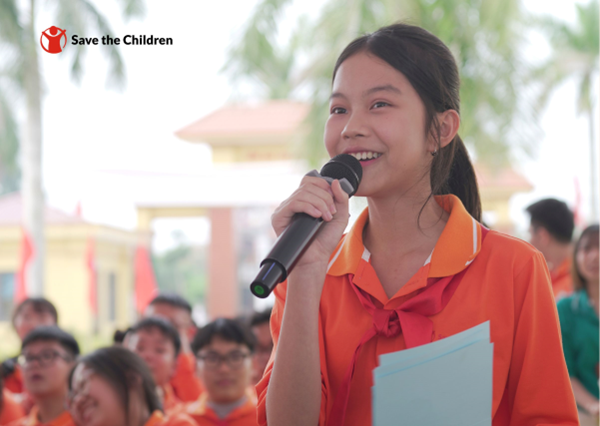
Photo: Linh facilitating a communication event on climate change.
Scaling up for lasting impact
The results demonstrate that child-centered, system-aligned climate education can drive measurable improvements in knowledge, behavior, and youth leadership. For Save the Children in Vietnam, the goal is not only to deliver projects, but to contribute to a scalable model embedded within the national education system.
Scaling requires formal integration of digitized materials into education platforms, sustained teacher capacity development, structured student participation mechanisms, and continued alignment with national climate and education strategies. Through close collaboration with government, schools, and communities, Save the Children is supporting the institutionalization of climate education as a core component of resilience-building.
As climate risks intensify, investing in children’s knowledge, skills, and leadership is both urgent and strategic. By connecting classrooms, ecosystems, and communities, Save the Children in Vietnam is helping nurture a generation capable not only of adapting to climate change, but of shaping a more sustainable future.